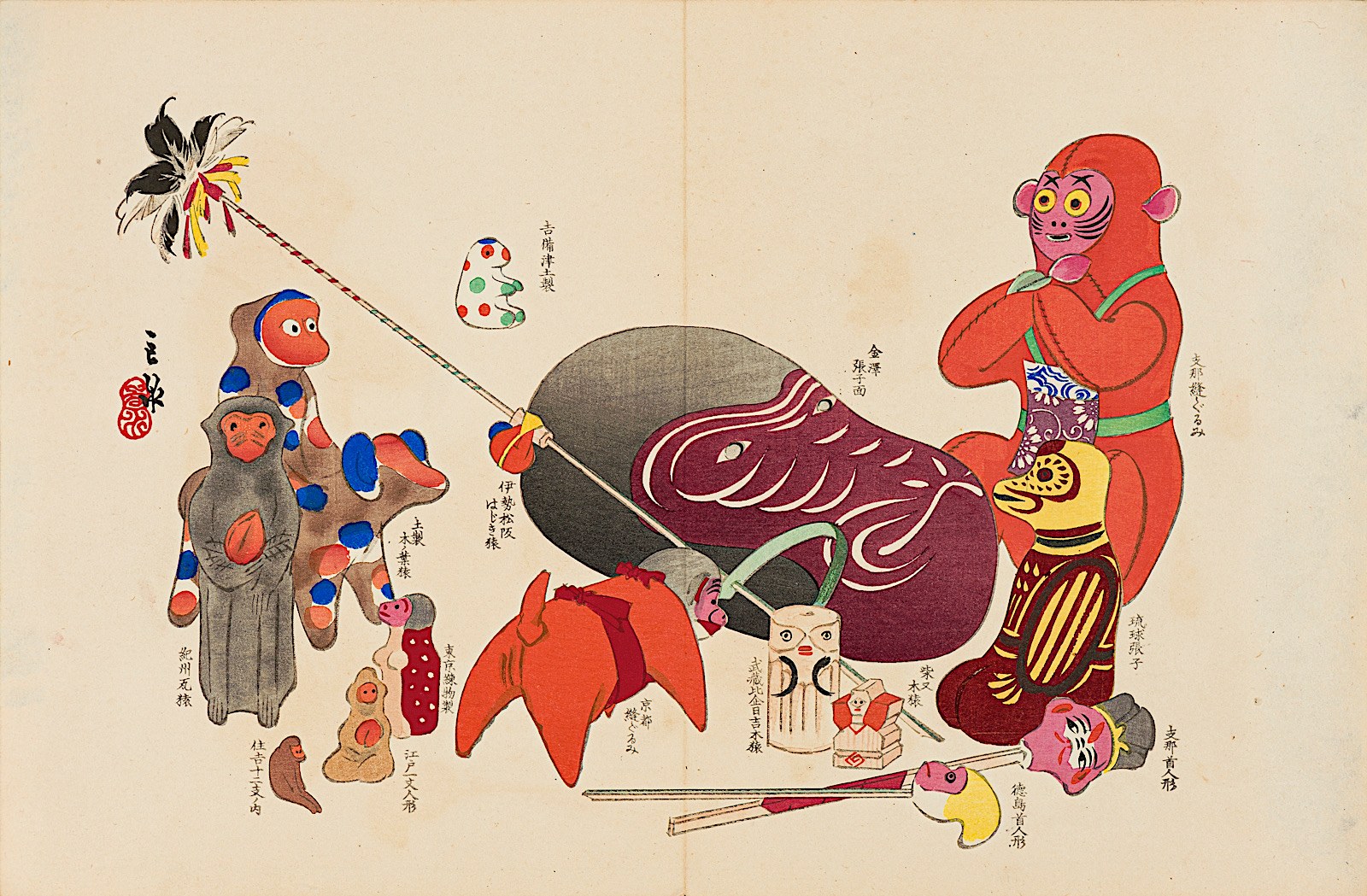
Color woodcut, ink, washi paper, 28x42 cm (paper size), artist's signature and hanko stamp
Rare woodcut by Kawasaki Kyosen from the album "Omocha Junishi" ("Toys of the Twelve Animals of the Zodiac"). The album was published in Osaka by Darumaya Publishing House in 1918. (Taisho 7). An analogous piece is in the Rare Books and Special Collections department of the Princeton University Library.
Woodcuts from "Omocha Junishi" depict the major talismans, dolls and toys assigned to each animal in the order of the 12-year zodiacal cycle. They are, in order, Rat, Ox, Tiger, Rabbit, Dragon, Snake, Horse, Goat, Monkey, Rooster, Dog and Pig. Each graphic contains about 10-15 colorful, overlapping toys, as if they were spread out on the floor, ready for play. Each has small printed text with the city, area or country of origin (Nagoya, Osaka, for example), period (like Edo), material (rubber, wood, paper) or other identifying details.
In Japan, the Chinese zodiac is still used. The monkey is the zodiac sign of people born in 2016, 2004, 1992, 1980, 1968, 1956....
Kawasaki Kyosen (1877-1942) was one of the most important artists and experts in children's folk toys and dolls of the 20th century. He was born as Kawasaki Suekichi in the town of Sakai near Osaka. From an early age he was identified with artistry and apprenticed with ukiyo-e artist Nakai Yoshitaki (1841-1899), best known for his prints depicting kabuki theater. Kyosen soon began working independently as a graphic designer, and by the end of his life he was devoted exclusively to depicting ephemeral folk toys and talismans known as omocha. By the turn of the 20th century, the fashion for collecting and classifying omocha had taken hold, and artists began creating colorful woodcuts known as omocha-e, which ranged from simple "toy pictures" to interactive paper dolls, board games and cut-paper dioramas. Kyosen's approach to omocha and omocha-e was very different from the trendy collector market. He viewed omocha as a living tradition. The lessons he took from Yoshitaki in his youth greatly influenced Kyosen's work, for in his works dynamic compositional arrangements reflect theatrical staging.
Circulated among adults and children alike, omocha were miniature objects of ritual significance, made from local materials to mark important events or religious holidays. Historically, each village had its own omocha tradition, thus reflecting Japan's cultural diversity. Many types of omocha were made from locally available materials and sold only on select ennichi (festival days) at or near specific temples. These omocha were an integral part of Japanese gift-giving practices, which included people at all stages of life making pilgrimages to temples and returning home with gifts. Typically, these items were discarded during the annual purification that took place in every household at the end of the year. Some dolls were even ritually burned and then bought anew on New Year's Day.
The term omocha in Japanese covers a wide spectrum of practical, decorative, instructional and ritual objects, only a small number of which exactly correspond to the word toy. Many omocha were as important to the adult world as they were to children. As Marguerite Hodge writes: Japan has one of the richest doll traditions in the world. Unlike many societies where dolls are mainly found in the children's sphere, the vast number and variety of dolls in Japan circulate among adults, often given as prestigious gifts at important cultural events such as weddings, promotions or state ceremonies.