


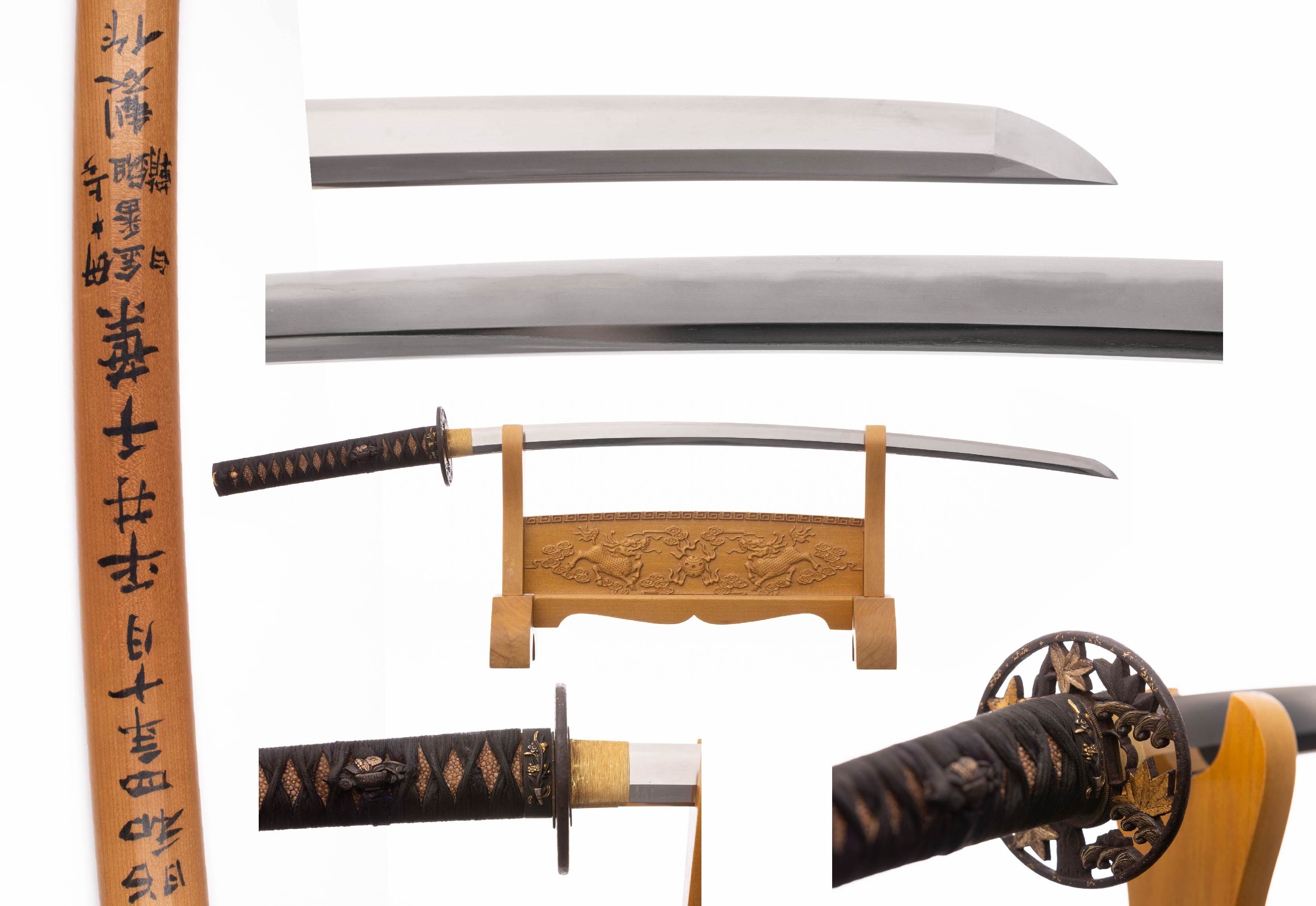
Katana signed "Bishu Osafune Kiyomitsu" with NBTHK certificate. The sword was originally in a sayagaki type setting, that is, a shirasaya described by a grinder. In this case it was Hibai Chiba of the Honami School, who polished the blade in 1965. The sayagaki-framed blade has been exhibited several times in various exhibitions: in 2019, at the Manggha Museum in Krakow, in an exhibition entitled "The beauty forged in steel". "Beauty forged in steel," in 2020 at an exhibition titled. "Having a Living Blade in the Hands" at the Ikikata Gallery in Podkowa Leśna, and was also auctioned at the "Nihon-tō" auction in 2021. The new frame of this sword (koshirae) was made from antique components, which are described in detail below. The former sayagaki frame has been preserved and adapted for display alongside the sword in full traditional koshirae. Kiyomitsu usually signed his works "Bishu Kuni Jyu Osafune Kiyomitsu" or "Bizen Koku Osafune Kiyomitsu." His works are not only beautiful, but technically superb, and as such are highly sought after by collectors. Kiyomitsu swords are in almost every study on the Bizen school.
The head is hand-forged from Japanese tamahagane steel with high resistance to chipping and mechanical injury. The blade is 62.8 cm long, of the shinogi zukuri type, with virtually no delamination (kizu), demonstrating a masterful level of craftsmanship. Overall it is in near perfect condition. The sword dates from the second half of the 16th century. It is extremely light and handy (the sword weighs 0.83 kg). The katana has the original Japanese cut with whitewashing. The blade has no armor (shavings, bo-hi), the blade is fixed on a single mekuga peg. The sword has a springy blade with good geometry. Habaki of brass, shims (seppa) of copper. Tsuba of iron, openwork (sukashi) in the shape of a circle. Made by the famous Shoami school. Decorated with an ornament in the shape of maple leaves falling from the tree straight into the waves. This motif is traditionally associated in Japan with the Tatsuta River. The entire piece is decorated with gold and silver inlay of the nonome zgoan type. The tsuba dates from the Edo period.
Fuchi and kashira of the same material, with decorative nanako with floral motif, decorated with gilding and silvering. Menuki of brass, also with floral motif, gilded in places. Scabbard (saya) wooden, made of magnolia wood, covered with shiny black lacquer, with buffalo horn trim. Strap (sageo) dark olive green, silk, with decorative weave. Handle (tsuka) 22.5 cm long, wooden, covered with patinated stingray leather (same-gawa). The sheath (tsuka ito) made of Japanese silk, black in color, with typical weave, with exposed menuki. The sword can be completely disassembled into individual pieces for maintenance or replacement. Maintenance work on all metal parts was performed on it (mainly cleaning and corrosion protection), the blade itself required no maintenance. The handle, scabbard and tsuba were also fitted, and the braid was preserved. In summary: koshirae made by hand, from antique parts, so that they form a set and match the blade.








Ostatnio oglądane
Zaloguj się aby zobaczyć listę pozycji
Ulubione
Zaloguj się aby zobaczyć listę pozycji