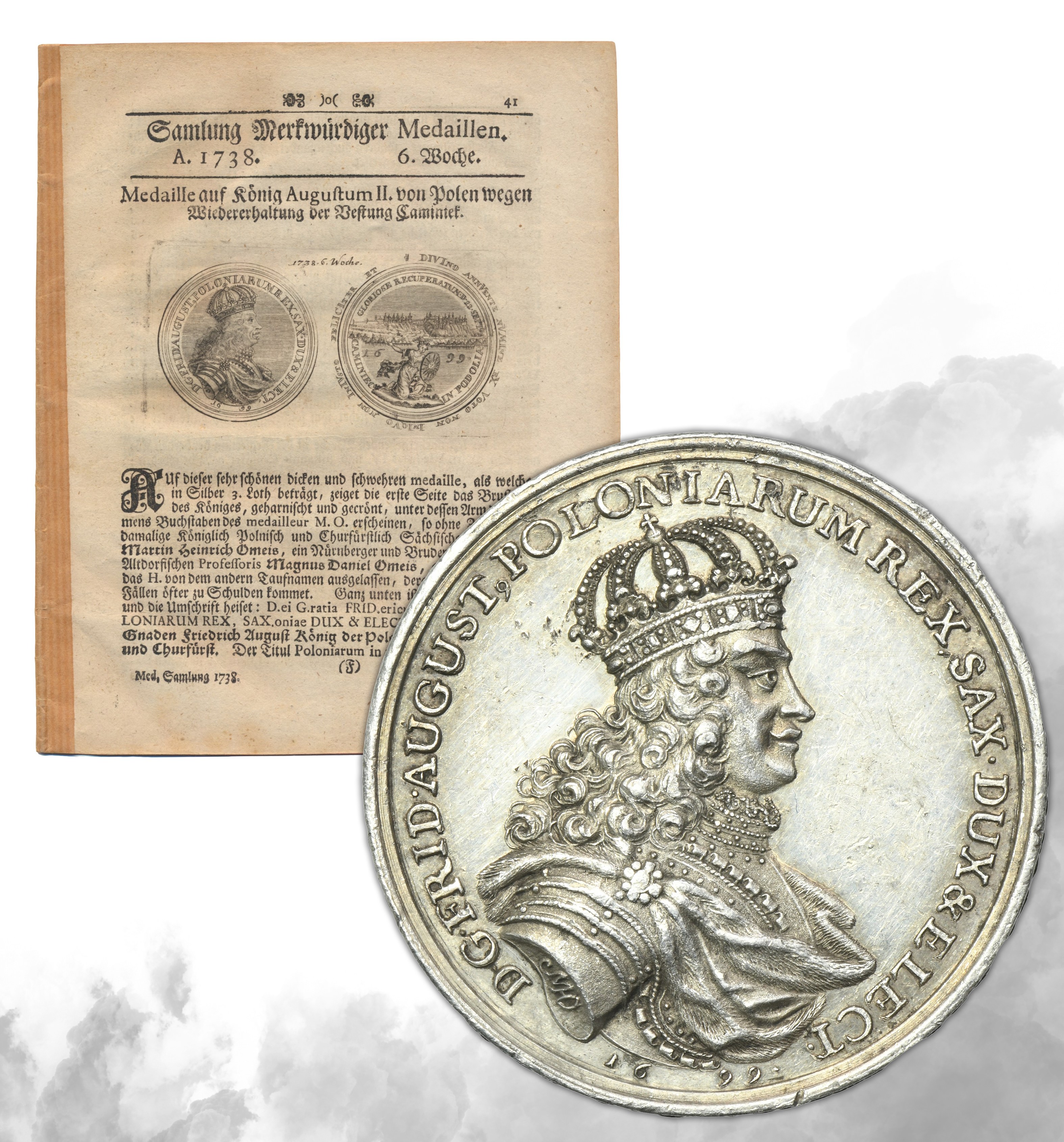
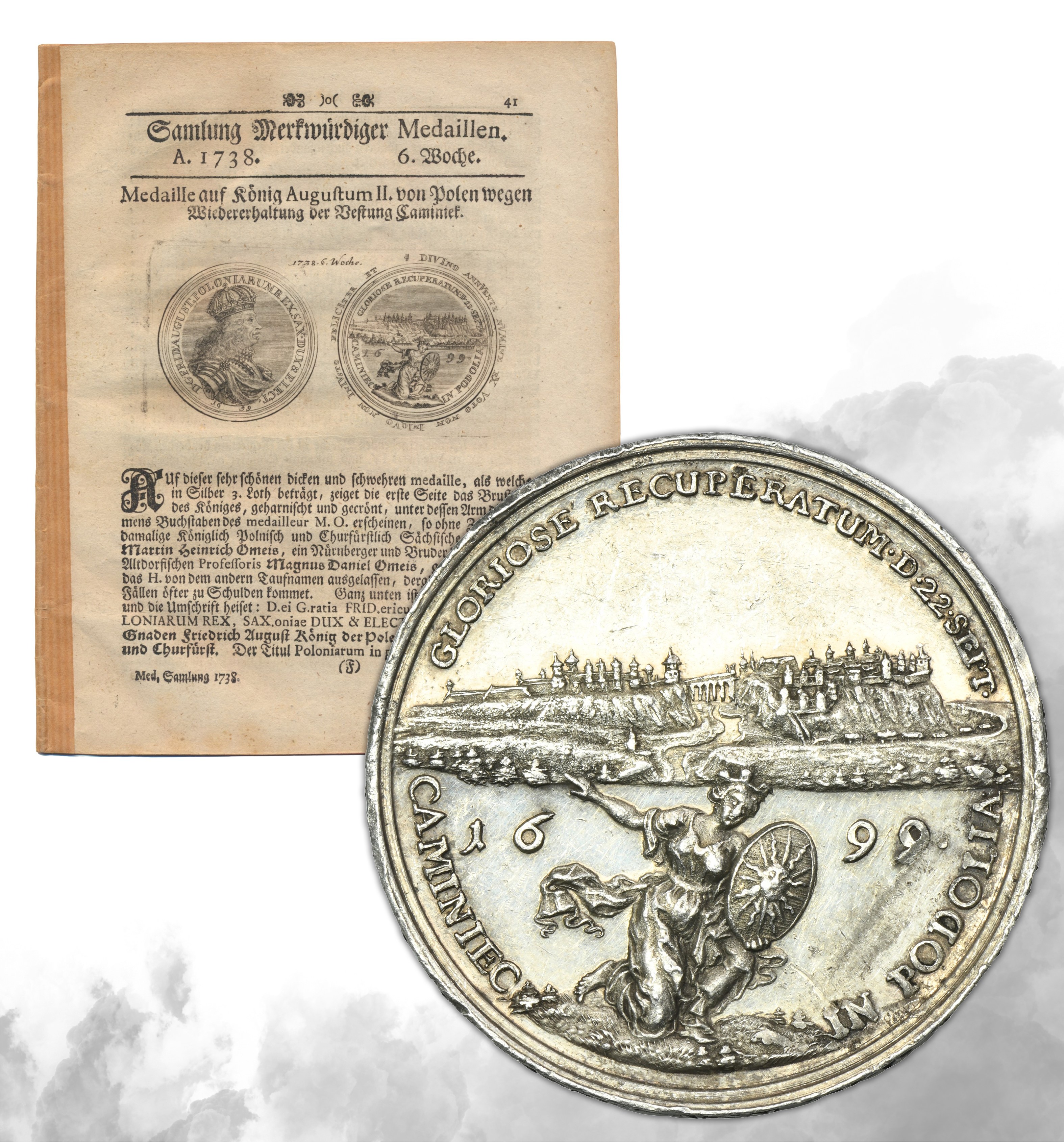
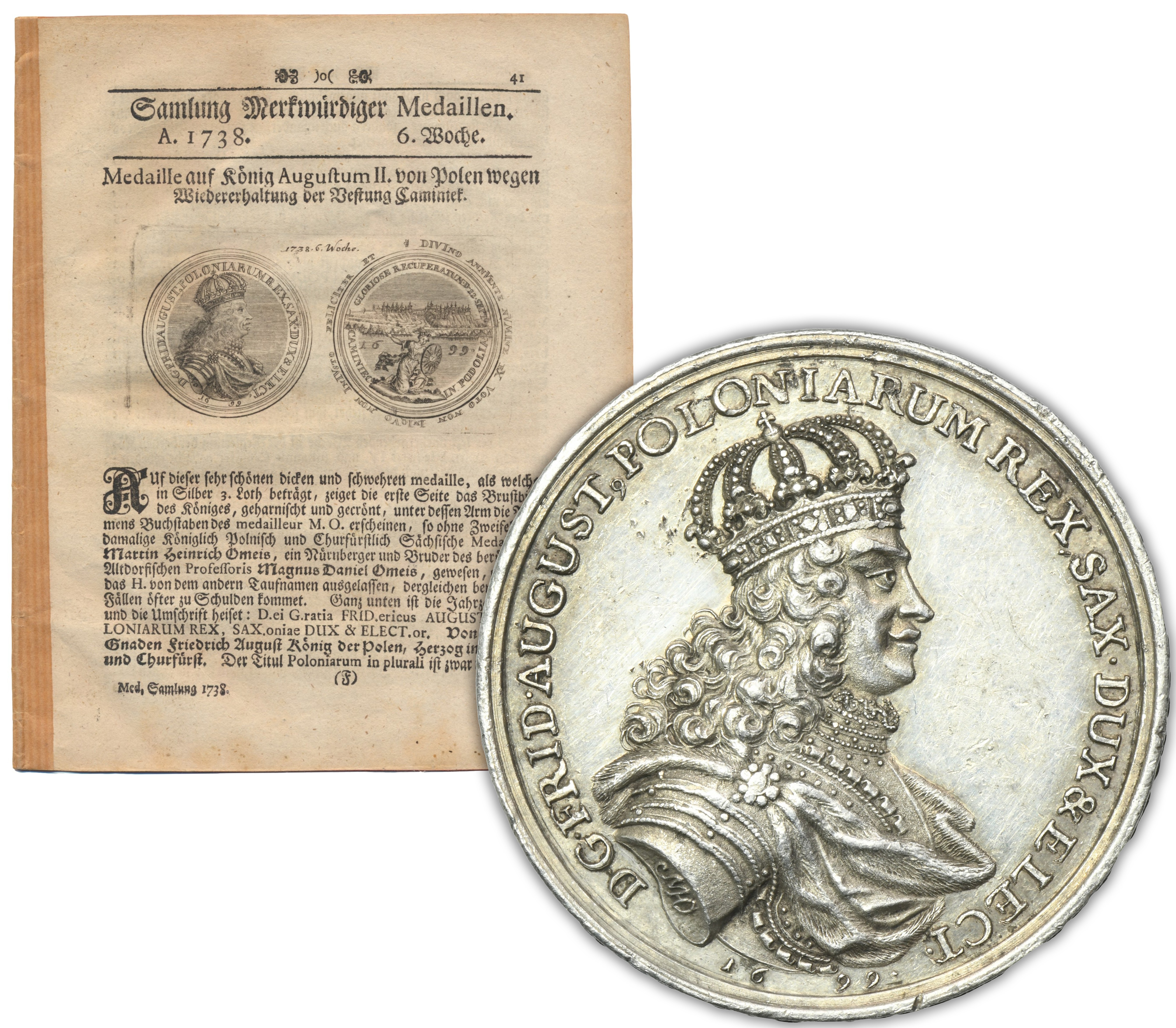
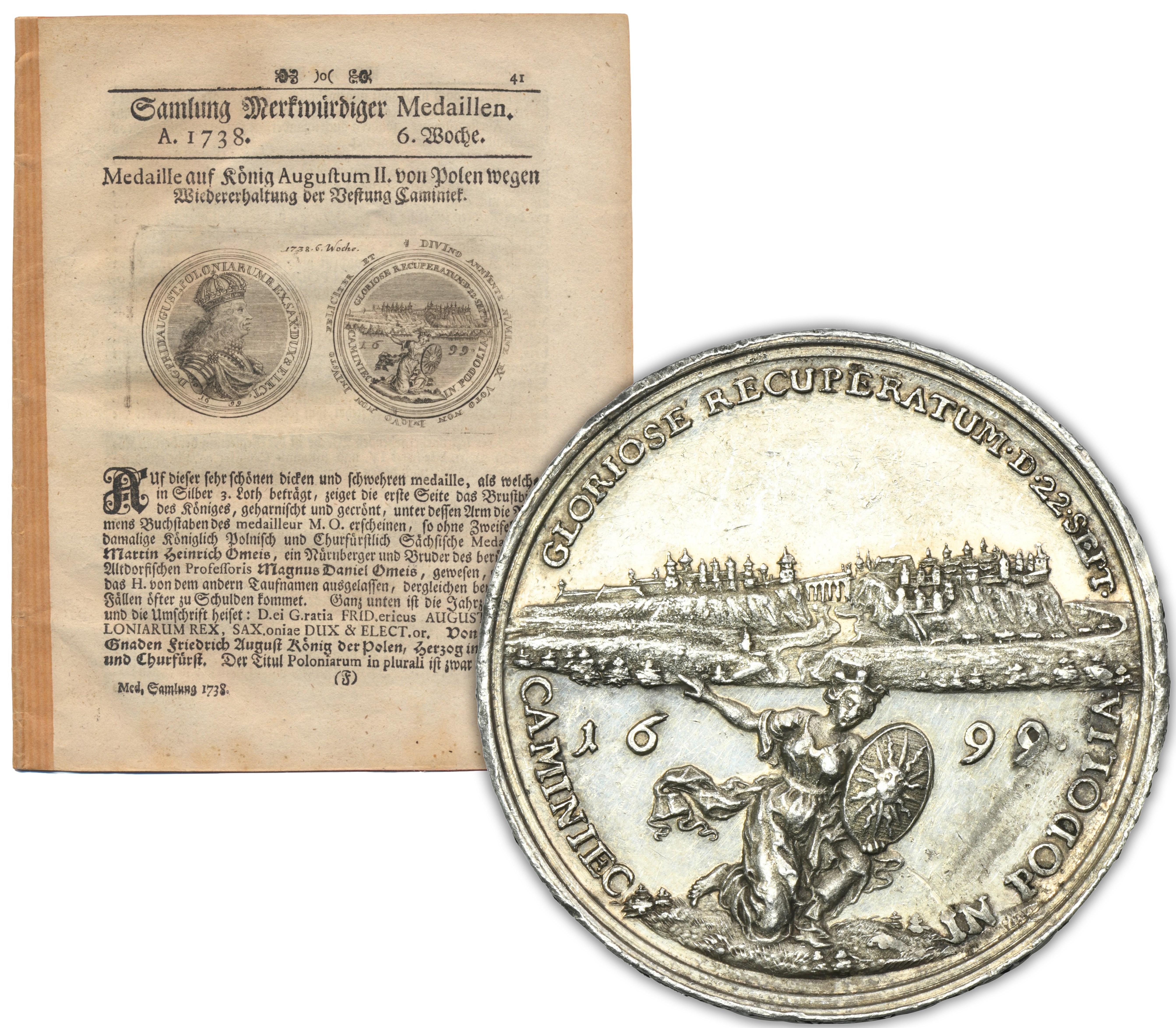
A rare medal commemorating Poland's recovery of Kamieniec Podolski, restored to the Crown under the Peace of Karłowice in 1699.
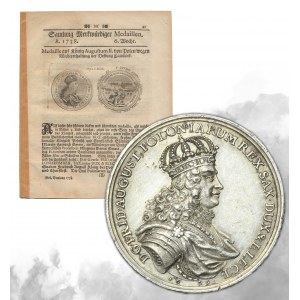
A medal designed by the court medalist Martin Heinrich Omeis, of a propaganda nature. In the Catalog of the collections of the Royal Castle, you may encounter the following description: "the corona muralis on the head of the personification of Kamianets-Podilskyi emphasizes the war merits and the ruler's personal participation in the victorious war with Turkey. The recovery of Podolia and the fortress was in accordance with the obligations contained in the pacta conventa sworn by the king."
A beautifully made, spectacular medal weighing 1.5 thalers with an impressive high relief.
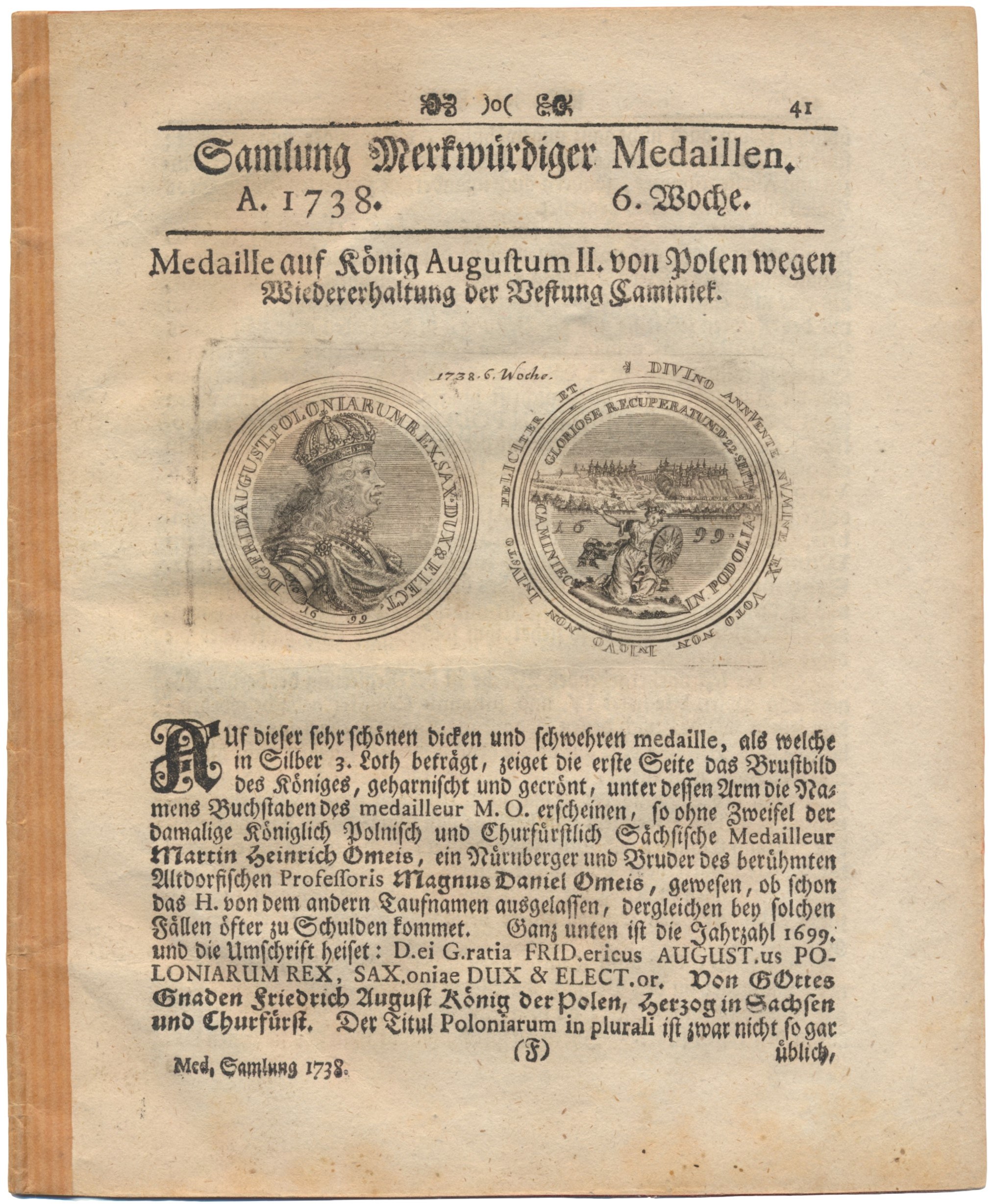
The medal is accompanied by a beautiful old print with a detailed description of the presented medal.
The relief is very nice, without significant abrasions, the background has a strong shine, but is also worn over the entire surface.
An impressive, rare and spectacular medal.
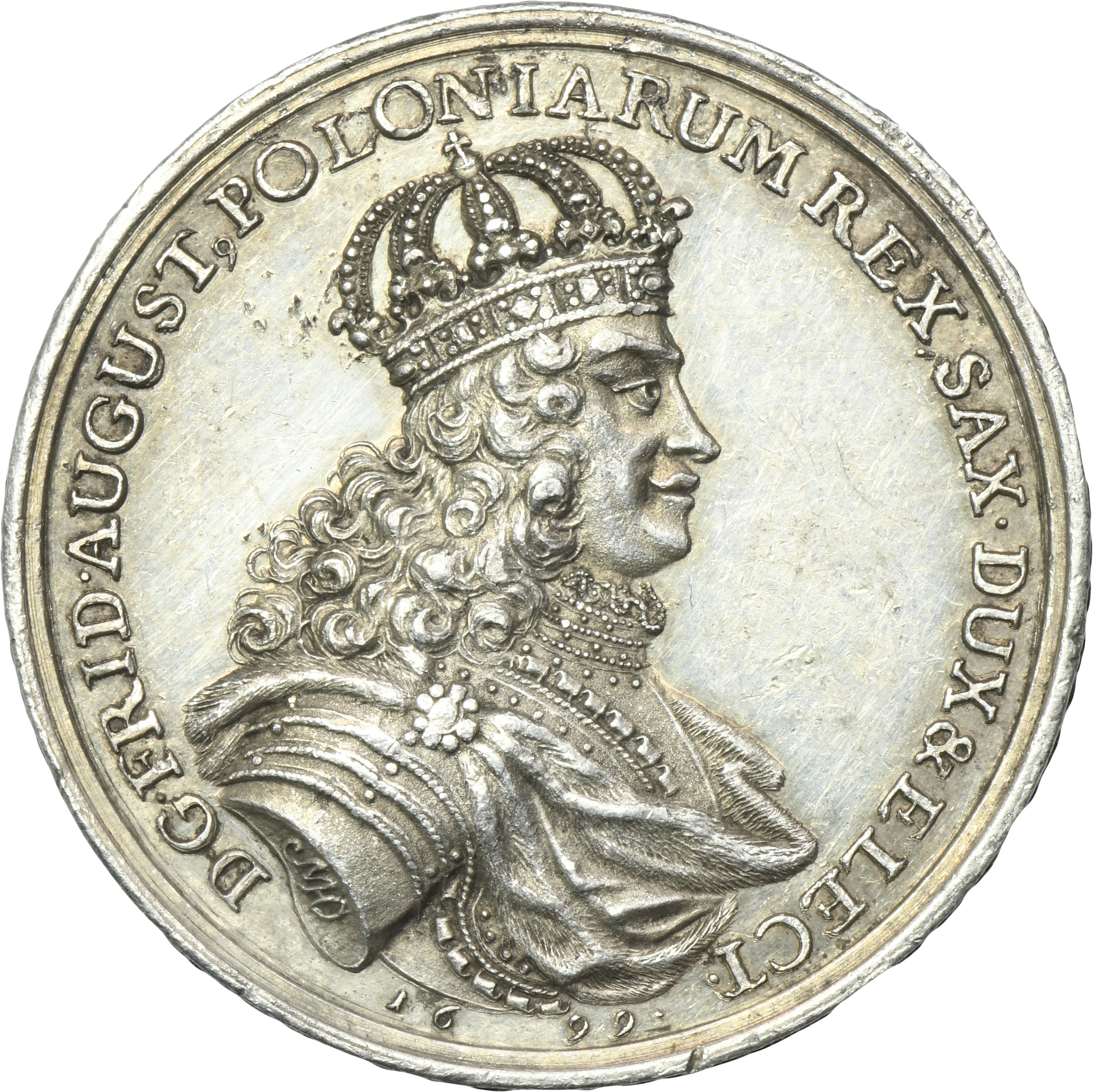
Obverse: crowned bust of Augustus II in armor covered with a cloak, with loose hair falling from under the royal crown, the medalist's initials MHO on the shoulder
DG FRID AUGUST POLONIARUM REX DUX & ELECT 1699
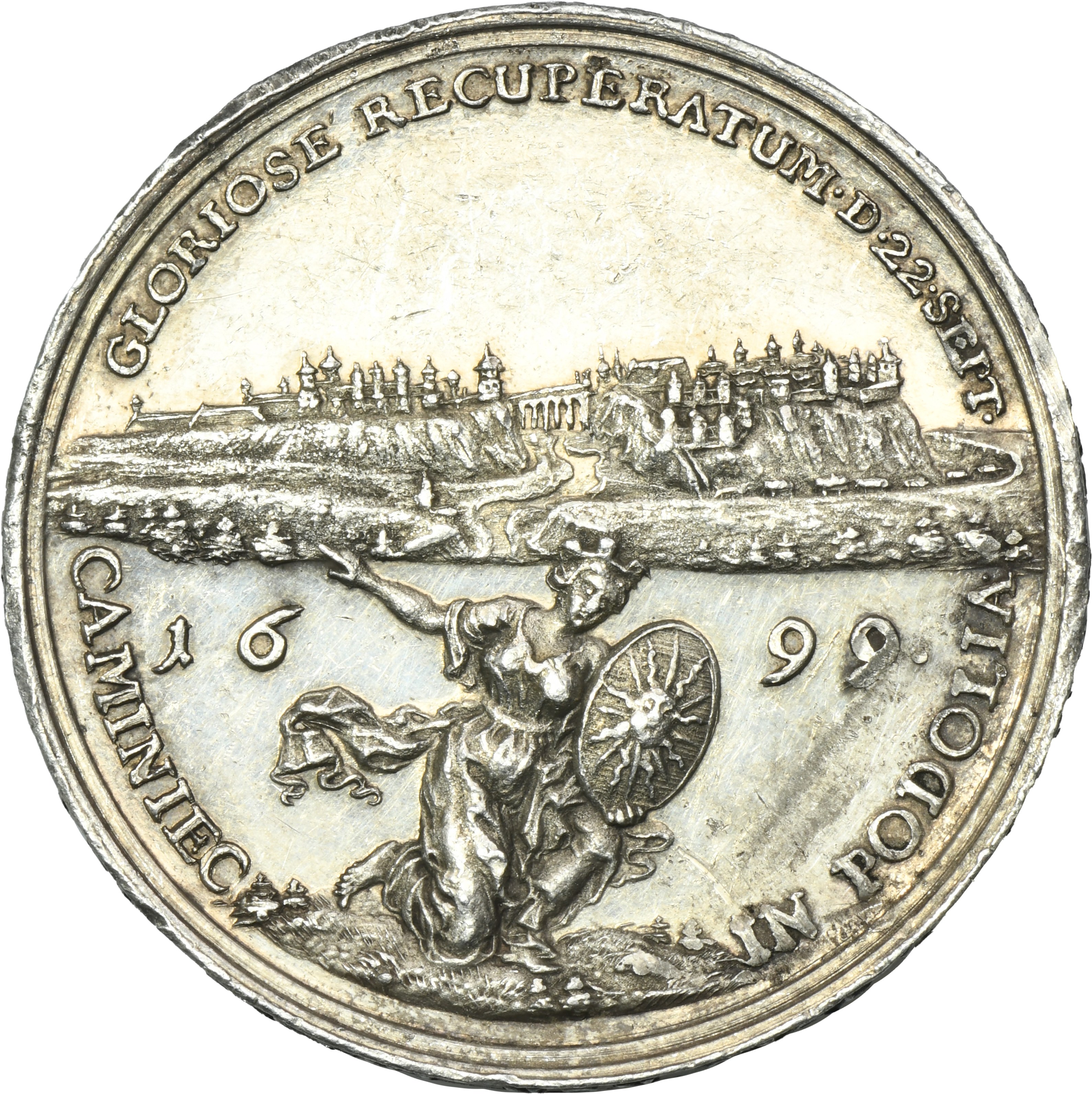
Reverse: a female figure wearing a corona muralis, personification of victory, holding in her left hand a shield decorated with the Sun, the coat of arms of Podolia, and in her right hand pointing to the panorama of Kamieniec
GLORIOSE RECUPERATUM D 22 SEPT CAMINIEC IN PODOLIA
Border: DIVINO ANNVENTE NVMINE EX VOTO NON INIQVO NON INIVISTO FELICITER ET

format_quote German authors who dealt with the numismatics of Augustus II do not mention anything about him, so it can be assumed that he was beaten after the death of Augustus II, when his son, who was trying to obtain the Polish crown, perhaps wanted to recommend himself to the Polish nation by reminding them of regaining the Polish crown. Kamieniec and Podolia thanks to my father's efforts. He also referred to the testimony of John Baptist Albertrandi, who wrote in the manuscript Descriptions of the medals of Polish kings along with an explanation of the circumstances that led to their minting: "The very sight of this medal when I saw it for the first time confirmed my opinion, because it was so new He seemed as if he had just come out from under the stamp.”In the article by Roman Marcinek "The medallion souvenir of the recovery of Kamieniec Podolski" placed in the knowledge base of the Museum of King Jan III's Palace in Wilanów, we read: "A suggestion worth a short analysis. The same stamp was used to make the obverse as the Omeis medal from the same year, dedicated to the Prince of Saxony Widukind (the Wettin dynasty was supposed to be descended from him), who fought against Charlemagne in the second half of the 8th century. The medal - minted in silver - has the same diameter and weight, and the entire rim with the inscription: REGES CREANTUR REGIBUS was used The reverse had to be ordered twice. Raczyński disputes the initiative of August II, but he is wrong. The argument refuting his claim is a fragment of Wilhelm Ernst Tentzel's work Saxonia Numismatica oder Medaillen-Cabinet von Gedächtniss-Müntzen, published in Dresden. III and is a description of our medal (p. 711). However, it cannot be ruled out that Augustus III decided to reissue it, making propaganda use of the memory of regaining the fortress - his father's greatest, if not only, merit.
A clue that could confuse the researcher is the bridge connecting the castle and the town, visible in the relief with the panorama of Kamieniec. Seriously damaged during the Turkish siege in 1672, it was renovated after 1685 by the occupiers - including its arcades were lined with stone (from the demolition of the Discalced Carmelite monastery), creating a uniform wall with a water culvert. Its former shape returned during the renovation that began in 1715. The view of Kamieniec is worth attention because, unlike other views of the fortress from that time, it faithfully reflects its location and scale. So we are dealing with a view from before 1685, the oldest realistic image of a borderland fortress, before the Turkish reconstruction. format_quote