


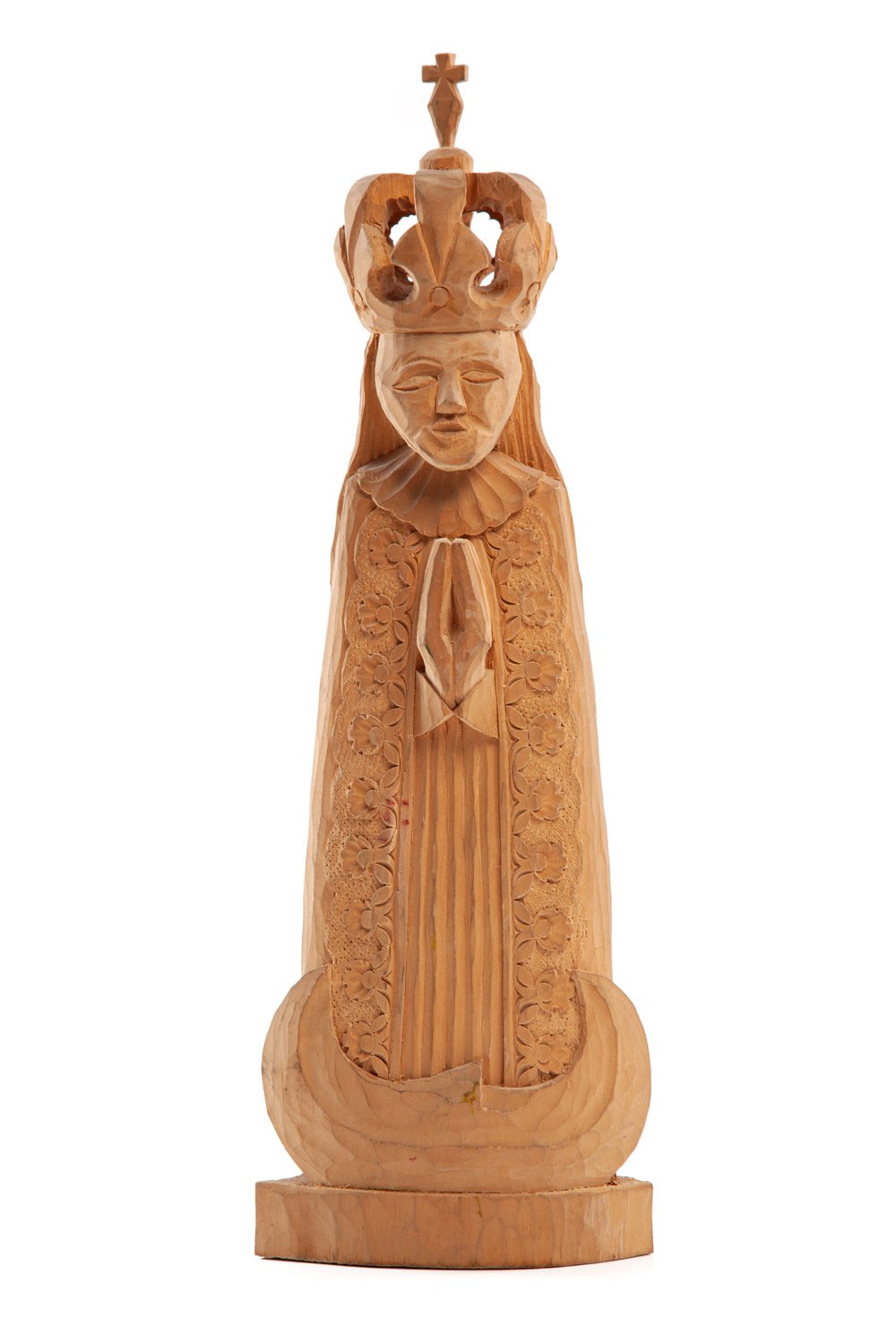
wood; 38 cm
on the bottom engraved: F.MAIK / 1980
Poland, 2nd half of the 20th century.
A memorial service was held at the cathedral parish on April 7. By participating in the Mass, family, relatives and friends bid farewell to sculptor Feliks Maik.
The artist was born in 1919 in Grodzisk Wielkopolski, to a poor, large family of craftsmen. Poverty meant that, despite his artistic talents, he ended his education by learning the carpenter's trade. Since childhood he dreamed of carving, and like many self-taught folk, he began his first attempts at carving in the pasture, while guarding cows. The learned carpentry craft opened up artistic prospects for him in the field of woodcarving and carving furniture details. Fate, however, decided otherwise. In September 1939. Feliks Maik, as a volunteer, went to war to defend the Fatherland, and when he returned home, he was sent by the Germans to forced labor in Lübeck.
After the war, in 1946, he settled in Wloclawek and took a job with the State Automobile Transport as a conductor. At that time he established close cooperation with the Kuyavia Museum and, "learning" the new region, he passionately made miniatures of Kuyavia's furniture and, from figural sculpture, mainly saints. He was fond of sculpting figures of Our Lady of Skepe and Sorrowful Christ. As souvenirs from the region, they were very popular at folk art fairs throughout Poland, in which the sculptor willingly participated.
Feliks Maik's sculptures, although inscribed in the folklore phenomenon of the time, retained their individual expression, resulting from the artist's love of decorativeness and precise detailing. Usually maintained in warm, vivid colors, Maik's works not only decorated fairs and various folk festivals, but were also eagerly purchased by the country's largest museums (Krakow, Warsaw, Torun) and regional museums (Wloclawek, Bytow). Maik also made decorative chess pieces and stamp clappers: philately - next to sculpture - was his second fervent passion.
He was active not only artistically, but was also active as a scoutmaster in the Polish Scouting Association. For two terms (in 1981-86), he served socially as president of the Folk Artists Branch in Wloclawek. He also prompted others to creative work.
Felix Maik's art, created for the "bourgeoisie," referred to folk roots. The passion with which the artist made his sculptures ensured that they would remain a lasting trace of attachment to tradition, to piety, of which the figure of the Skepe Madonna was a visible sign in our region.
(source: niedziela.pl)











Ostatnio oglądane
Zaloguj się aby zobaczyć listę pozycji
Ulubione
Zaloguj się aby zobaczyć listę pozycji